The Confidence We Overlook in Times of Change

Self-confidence feels most fragile exactly when we need it most.
In times of change.
In complexity.
In situations where predictability disappears and certainty is no longer available.
It is precisely then that many people begin to doubt themselves.
Not because they have suddenly become less capable,
but because the conditions no longer provide the stability they are used to relying on.
We often associate confidence with knowing.
With having answers.
With being prepared.
With being certain.
But in complex and unpredictable environments, these sources of confidence are no longer reliable. And this is where a different source of confidence becomes essential.
There is one capacity that remains available even when certainty is not:
our ability to learn, adapt, and change.
When we really look at this, most of us have far more evidence for this capacity than we tend to acknowledge.
We have learned before.
We have adapted before.
We have changed — often in ways that were not easy, not linear, and not comfortable.
Learning and change are rarely neutral experiences.
At times, they are genuinely enjoyable.
But quite often, they are not.
They can be painful — literally or metaphorically.
Painful because they come with effort that takes a toll on our physical state:
sleepless nights, sustained pressure, extended periods of focus and strain.
Painful because they can be emotionally overwhelming:
moments of doubt, frustration, or even a sense of being stretched beyond what feels manageable.
Painful because change often requires us to part with something familiar —
a way of working, a belief, a sense of identity.
And painful because learning frequently involves failure.
It is easy to say that we should celebrate failure.

From a philosophical perspective — and looking back in time — this makes sense.
But in the moment, failure hurts.
It challenges how we see ourselves.
It brings discomfort, sometimes even shame or disappointment.
Because of this, when we look back at periods of change, we tend to remember the exhaustion.
The emotional toll.
The struggle.
The effort it took to push through.
And this can quietly create a misleading conclusion: that we are not good at dealing with change.
But this is not accurate.
If we look more closely, something else becomes visible.
We did learn.
We did adapt.
We did change.
And more importantly: we translated that experience into something usable.
We extracted insights.
We developed new ways of thinking.
We built skills.
We turned experience into capability.
When these insights and learnings become embodied — when they become part of how we think and act, almost like muscle memory — something shifts.
We are no longer simply someone who “went through something difficult.”
We become someone who can handle what comes next.
This is where confidence comes from.
Not from knowing in advance.
But from knowing that we can learn, adjust, and respond.
In times of uncertainty and complexity, this distinction matters.
Because the question is no longer:
“Do I know what will happen?”
But rather:
“Do I trust my ability to deal with what happens?”
And for most people, the honest answer — when they look at their own history — is yes.
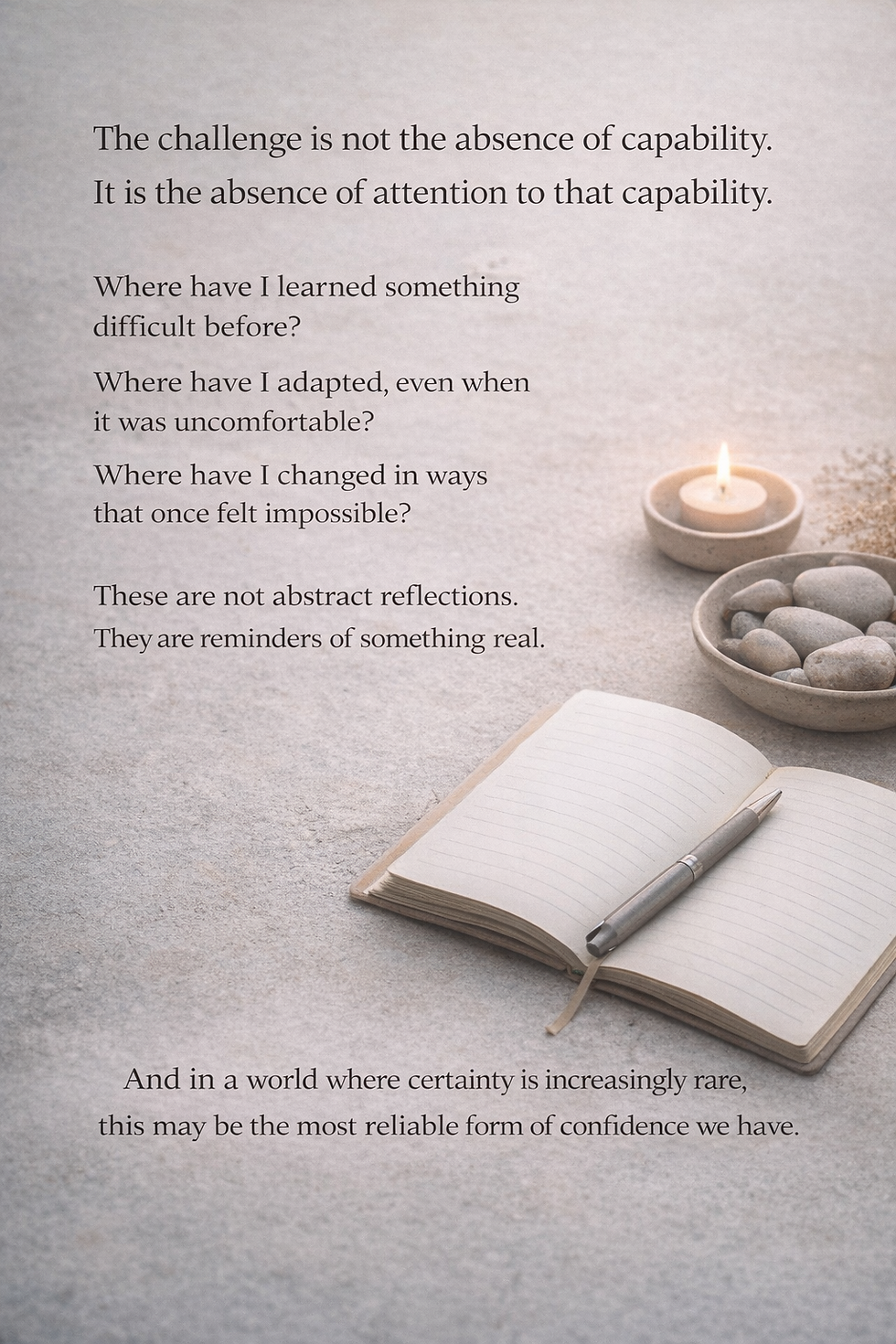
The challenge is not the absence of capability. It is the absence of attention to that capability.
Which is why, especially in times of change, it becomes important to consciously reconnect with this evidence.
To revisit:
Where have I learned something difficult before?
Where have I adapted, even when it was uncomfortable?
Where have I changed in ways that once felt impossible?
These are not abstract reflections.
They are reminders of something real.
Confidence is not built only by looking forward.
It is strengthened by recognizing what we have already done.
And in a world where certainty is increasingly rare, this may be the most reliable form of confidence we have.


Comments